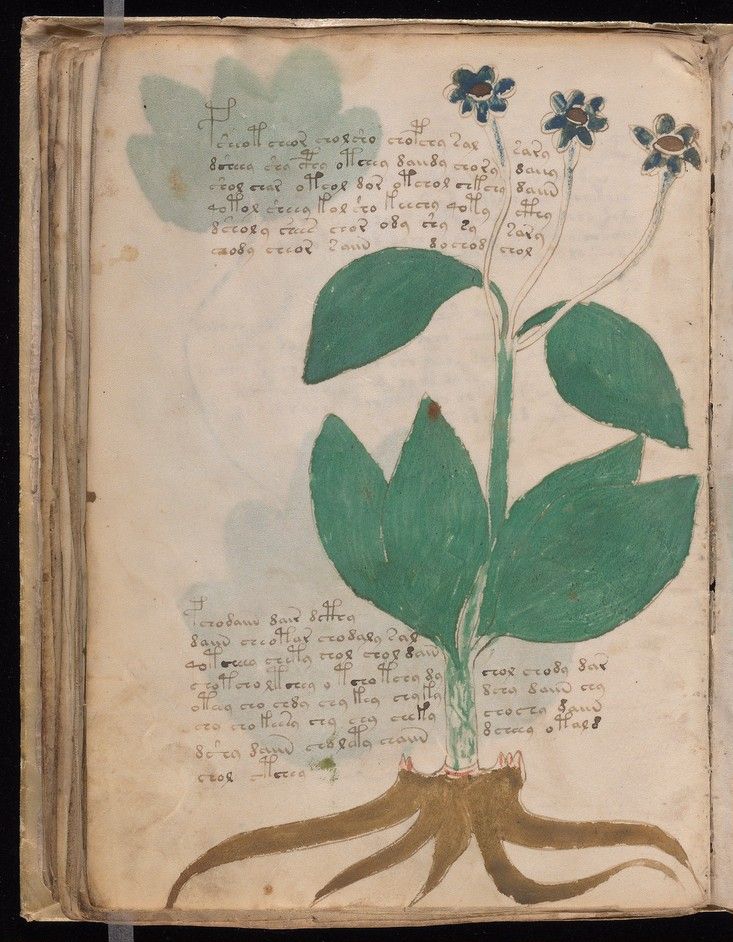
The Plant That Does Not Exist
Although it was well and intelligibly figured and painted, yet no man could ever have been able to understand it without being well skilled in their Cabala, which goeth by tradition, and without having well studied their books. — Nicolas Flamel, on the Book of Abraham the Jew
The plant does not correspond to any known species. Botanists, cryptographers, linguists, computer scientists, and amateur codebreakers have studied it for a century. It remains a plant that does not exist, painted by someone who may have seen it.
Folio 2r. A single plant with blue star-shaped flowers, broad green leaves, and a root system that looks like it was drawn from life by someone who understood how roots work. The text around it flows in an alphabet that has consistent internal patterns — word lengths, character frequencies, line structures — all suggesting a real language or cipher. But no one has ever broken it.
Every few years someone claims to have decoded the Voynich. They publish a paper. Other scholars examine it. The decryption falls apart. The manuscript returns to silence.
The plant was painted by someone who could draw. The text was written by someone who could write. The book was bound by someone who understood bookmaking. Everything about it suggests competence except the one thing that would make it useful: legibility. It is a book that does everything a book does except communicate.
Or it communicates perfectly, and we are not the audience.