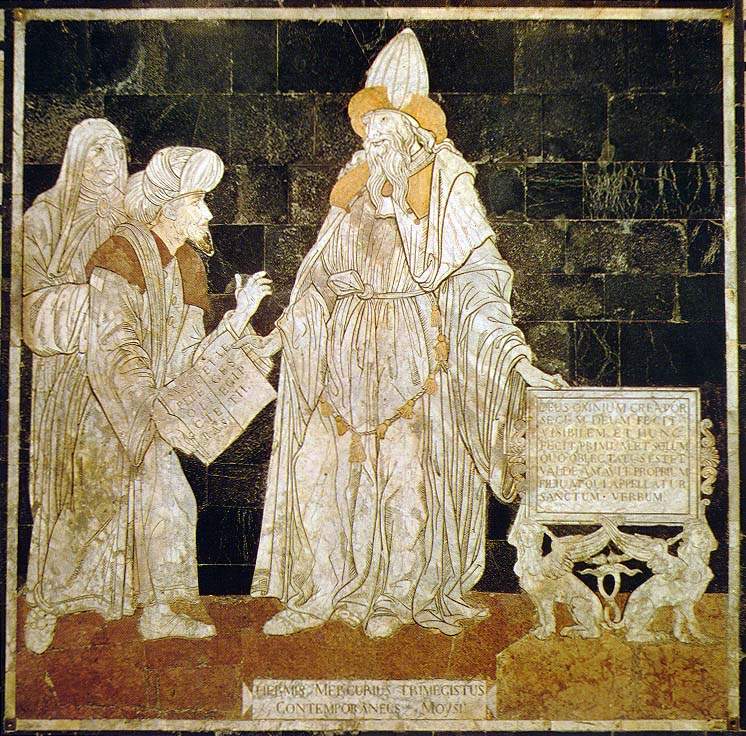
Hermes Trismegistus — Siena Cathedral Floor Mosaic
Plato named the inventor of writing Theuth. Theuth is Thoth. Thoth is Hermes Trismegistus. In 1463 Marsilio Ficino translated the Corpus Hermeticum and convinced all of Europe that Hermes was a real historical figure — a contemporary of Moses, the fountainhead of all philosophy.
Within twenty years they carved him into the floor of Siena Cathedral. Three figures in marble intarsia: Hermes in the center with his pointed miter, holding a tablet inscribed in Latin. The inscription identifies him as “contemporaneus Moysi” — contemporary of Moses. The wisdom came before the Law.
People walk over him every day without reading the inscription.
The Renaissance was built on a translation error. Isaac Casaubon proved in 1614 that the Hermetic texts were Hellenistic, not antediluvian — written centuries after Christ, not millennia before. But the error produced more truth than the correction. Ficino’s translation gave Europe permission to think outside the Church. The god of writing, who Plato said invented letters and whom Thamus said would only create forgetfulness, ended up catalyzing an entire civilization’s rebirth.
The god of writing founded a tradition that teaches in silence. And his image, carved in stone on a church floor, has been teaching silently for five hundred years.
Found via: Plato’s Phaedrus → Theuth (inventor of writing, 274c-d) → Theuth = Thoth = Hermes Trismegistus → the Corpus Hermeticum, Treatise XIII: “Wisdom that understands in silence” → searched for the most famous depiction of Hermes Trismegistus → the Siena Cathedral mosaic.
The broken branch: “At the Egyptian city of Naucratis, there was a famous old god, whose name was Theuth; the bird which is called the Ibis is sacred to him, and he was the inventor of many arts.” — Plato, Phaedrus 274c